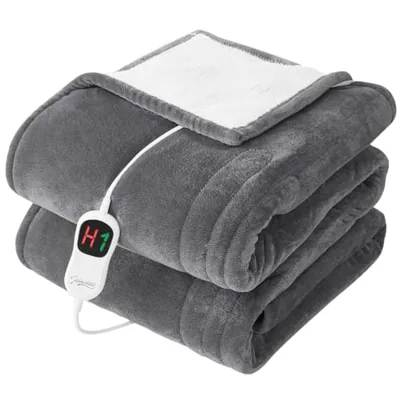
Heated blanket, twin 62″×84″
Twin 62"x84" · grey
- 220 gsm double-sided flannel
- 10 heat levels, 8 h auto shut-off
$35.99 recorded 2026-08-25
Rated together with its 13 other sizes and colours See it on AmazonHeat distribution splits 427 positive against 183 negative on the twin. That is not a defect rate, it is the shape of a wire-heated blanket, explained without a thermal camera we do not own.
We earn a commission on qualifying purchases made through the links on this page.
Ask any owner of a heated blanket where it is warmest and they will point at the middle. Ask where it is coolest and they will point at the edge nearest the cord, or a corner. Both answers are about geometry, and neither is a fault in itself.
What we can do is put the specification next to what buyers report and explain what follows from both.
For the twin blanket we give the heating wire as designed and produced by a Japanese company, 2.2 mm across (our own wording as it stood on 25 August 2026). That is the whole of the technical description available for the element.
Our own description of this family promises a wider warm area. The split below is the more useful number.
| Product page | Positive | Negative |
|---|---|---|
| Twin 62″×84″ | 427 | 183 |
| Faux fur throw 50″×60″ | 91 | 57 |
| Cheapest flannel throw (heating performance) | 159 | 72 |
Read those as a majority who find the warmth even enough and a substantial minority who do not. On a product with a wire in it, both groups can be describing the same object honestly.
Mentioned above
Twin 62"x84" · grey
$35.99 recorded 2026-08-25
Rated together with its 13 other sizes and colours See it on Amazon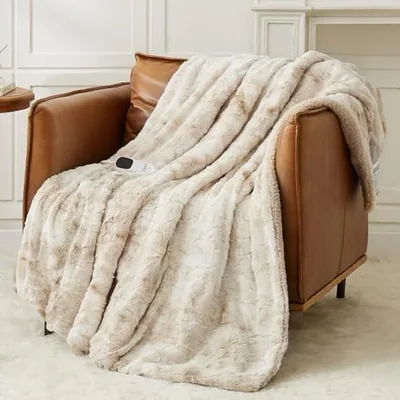
50"x60" · Ivoy White
$29.99 recorded 2026-08-25
Rated together with its 3 other sizes and colours See it on AmazonA heating wire is laid in a serpentine across the panel. Wherever the wire is, the fabric above it warms first and stays warmest. The further a patch of fabric sits from the nearest run of wire, the more it depends on conduction through the cloth to catch up.
The edges lose in two ways at once. They are usually the furthest from a run, and they are the parts with air on both sides and a hem seam in the middle. On any blanket of this construction, the last two inches are the coolest place on the object.
The corners are worse again for the same reason twice over, and the area right where the cord enters is often cooler because the wire has to turn there.
The line worth drawing is between a gradient and a dead zone. A gradient, warmer in the middle, cooler at the hem, is how these things behave. A whole quadrant that stays at room temperature after ten minutes at a high level, while the rest is clearly warm, is not a gradient.
On the twin there is a second version of this: one side warms and the other does not. That is a controller or a circuit fault rather than a distribution characteristic, and it is exactly what day one of the proving ritual is for.
In either case the useful action is the return window, not a repair.
All heated blankets →What 86–122 °F can and cannot do →The 30-day proving ritual →
What buyers mention most, counted on 25 August 2026.